
What Happens to Your Car Loan When You Trade In Your Vehicle?
When you trade in a financed car, the dealer pays off your lender, your old loan closes, and whatever is left over, positive or negative, moves into your new deal. The whole thing usually takes a few business days. Here is the step-by-step, in the order it actually happens.
1. The short version
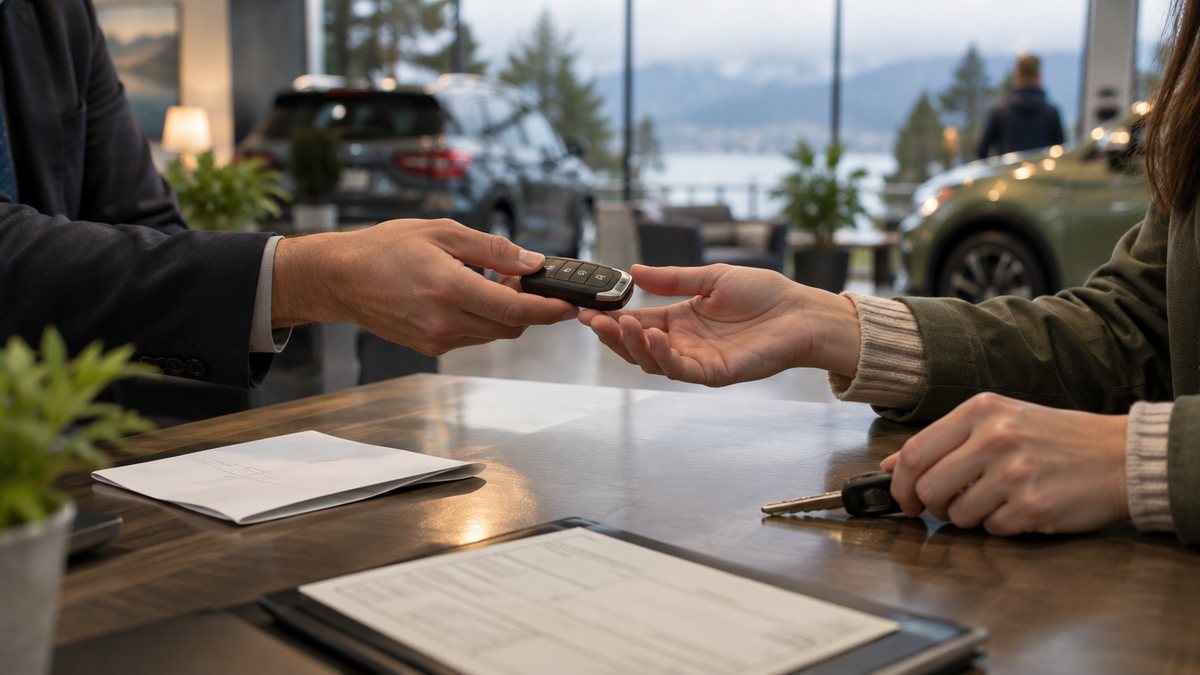
When you trade in a car you are still paying for, three things happen, in this order. You and the dealer agree on what the car is worth. The dealer asks your lender what it would take to pay the loan off today (the payout). Then the dealer buys the car from you, sends the payout to your lender, and gives you the difference, either as money toward your next car or, if you owe more than the car is worth, as an amount you need to cover. Your old loan closes. A new loan, if you are financing the next car, starts fresh. That is the whole thing. The rest of this guide is the detail, step by step, in the order it actually happens.
If you want the deeper treatment of equity, negative equity and the BC tax break on trade-ins, read our companion guide, How to Trade In a Car With a Loan in BC. This one is for the mechanics.
2. First, what a lien is and why it matters
When a lender finances a car, it registers a lien (a security interest) against the vehicle in the BC Personal Property Registry. That registration is public, it follows the car, and it means the lender can repossess the vehicle if the loan is not paid, whoever owns it. So no dealer will buy a car with a lien on it without paying the lender first, and no sensible private buyer should either. The lien is the reason the dealer, not you, handles the payout: the dealer needs to see it discharged before it can sell the car to the next person.
3. Step by step, in order
Step 1: appraisal
The dealer inspects the car and gives you a written trade-in value. This number is independent of your loan. A $17,000 car is worth $17,000 whether you owe $2,000 or $20,000 on it.
Step 2: the payout letter
You, or the dealer with your written authorization, ask your lender for a payout statement, typically valid for 10 days. It shows the principal, interest to the payout date, a daily interest figure, and any fees. This is the number that matters, and it is different from the balance in your banking app because the app usually shows principal only.
Step 3: the equity line
Trade-in value minus payout equals your equity. If it is positive, it is applied to the new deal as a down payment, or paid to you if you are not buying. If it is negative, you pay the difference or, with lender approval, it is added to the new loan. Either way, it should appear as its own line on the bill of sale.
Step 4: signing
You sign the bill of sale for the new car (if any), the trade-in documents, the ICBC transfer form (APV9T) and, if you are financing, the new loan agreement. You also sign an authorization letting the dealer pay off your lender. You hand over the registration, the keys and the car.
Step 5: the dealer pays your lender
Usually by electronic transfer within two to five business days. Reputable dealers pay promptly because they cannot sell the car until the lien is gone. The dealer receives confirmation and the lender discharges the lien in the registry.
Step 6: your old loan closes
The lender applies the payout, closes the account and sends you a confirmation, sometimes by mail a few weeks later. If a scheduled payment came out between signing and the payout landing, the lender refunds the overpayment. This happens often and is not a problem, but it is why you should not cancel your automatic payment until the account shows zero.
Step 7: insurance and registration
Your Autoplan broker transfers your policy to the new vehicle. The dealer submits the transfer paperwork for the old car; ICBC's selling a used vehicle page explains what a seller is responsible for. Keep a copy of the signed transfer form until you see the car is no longer registered to you.
4. A realistic timeline
| When | What happens | What you should do |
|---|---|---|
| Day 0 | Appraisal, payout letter, deal signed, keys handed over | Get copies of everything; note the payout amount and the per-diem |
| Days 1 to 5 | Dealer sends payout to lender | Nothing; keep your automatic payment active |
| Days 3 to 10 | Lender applies payout, discharges lien | Log in to your lender account and confirm the balance is zero |
| Days 10 to 20 | Any overpaid instalment refunded; closure letter mailed | Cancel the automatic payment if the lender has not; file the closure letter |
| Day 30 | Credit bureaus show the old loan as paid and closed | Check your Equifax report; the loan should read "paid as agreed" |
5. What it does to your credit
Paying off an installment loan and opening a new one causes a small, temporary dip in most Canadian scoring models: the old account's payment history stays on your file as a positive, but a brand-new loan has no history yet and there is a hard inquiry from the new application. The dip is usually 10 to 20 points and recovers within a few months of on-time payments. The Financial Consumer Agency of Canada has a plain-language explanation of how payment history and credit inquiries affect your score. What actually damages credit is the scenario in section 6: a missed payment during the changeover because someone cancelled the automatic payment too early.
6. Four things that go wrong, and how to prevent them
- A missed payment during the handover. The buyer cancels their automatic payment on signing day, the payout takes a week, a payment date passes, and the lender reports it late. Prevention: leave the payment active until the balance reads zero.
- The payout letter expires. The deal drags past the 10-day window, the number changes, and there is a small shortfall. Prevention: ask what the per-diem is and confirm the dealer is paying the amount as of the payout date, not the letter date.
- Two names on the loan, one signature. A co-borrower or co-signer has to sign the trade-in authorization too. Prevention: check the registration and the loan agreement for a second name before the appointment.
- The lien is not discharged. Rare with established dealers, serious when it happens. Prevention: a month after the deal, run a lien search on the old VIN in the Personal Property Registry. It costs a few dollars and takes two minutes.
7. If you are not buying another car
Everything above works even if you just want out of the car. A dealer can buy your vehicle outright, pay your lender, and pay you the positive equity. If your equity is negative you would need to pay the difference to close the loan, and in that case it is worth comparing a private sale, which usually brings a higher price but requires the buyer to be comfortable paying a lender they have never met. Our guide to selling your car in BC covers how to do that safely, and our online offer form gives you a number to compare against in a few minutes.
Frequently Asked Questions
What happens to my car loan when I trade in my car?
The dealer pays your lender the payout amount, the loan is closed and the lien is released. The difference between your trade-in value and the payout is your equity, which is applied to your next car or paid to you. The loan does not transfer to anyone.
Do I need to pay off my car loan before trading in?
No. The dealer pays it off as part of the transaction. You only need to cover the shortfall if you owe more than the car is worth and the lender will not roll it into a new loan.
How long does it take for the dealer to pay off my loan?
Typically two to five business days after signing. The lender then applies the payout and discharges the lien within another few days. Keep your automatic payment active until the balance shows zero.
Will a payment still come out after I trade in?
It can, if a payment date falls between signing and the payout being applied. The lender refunds any overpayment once the account is closed. Do not cancel the payment early or you risk a reported late payment.
Does trading in a financed car hurt my credit?
Only slightly and briefly. Closing one installment loan and opening another causes a small temporary dip that recovers with on-time payments. A missed payment during the changeover is what causes real damage.
How do I confirm the lien was released?
Search the old vehicle's VIN in the BC Personal Property Registry about a month after the trade-in. A discharged lien no longer appears. Your lender should also send a closure confirmation.
What we actually see at our New Westminster showroom
Most trade-ins with a loan take about 45 minutes longer than a cash trade, and nearly all of that is waiting for a lender to send a payout letter. So we ask for the lender's name when the appointment is booked and request the letter before the customer arrives. By the time the appraisal is done, the number is usually in hand.
The one piece of advice we repeat to every customer, sometimes twice, is not to cancel the automatic payment. We pay lenders within a few business days, but a payment date that lands in that window will still come out, and the refund from the lender is painless. A late mark on a credit file is not. Everything else, the payout, the lien discharge, the ICBC transfer, is our job, and you get copies of all of it before you leave 12th Street.
Sources & official references
This guide reflects our day-to-day experience at our New Westminster showroom and is cross-checked against official sources. Rules, rates and warranty terms change; always confirm current details with:
Trade in with a loan, without the paperwork stress
Bring the registration and your lender's name. We handle the payout letter, the lien release and the transfer.