
How Much Accident History Is Too Much on a Used Car? Reading BC CARFAX Claims
Most used cars in BC have at least one claim on their CARFAX, and many of them are fine. The skill is telling a $1,800 parking-lot bumper from a $14,000 structural repair. This guide shows you how to read the report the way an inspector does.
1. Why BC CARFAX reports look scarier than they are
Here is the thing most out-of-province buyers do not know: British Columbia has a public auto insurer, ICBC, and ICBC shares claims data with CARFAX Canada. That makes a BC CARFAX one of the most complete vehicle histories in North America. It also means a BC car's report lists things that never appear on an Alberta or Ontario car: a $900 windshield, a $1,400 keyed door, a $2,200 hit-and-run in a Costco parking lot.
So when you compare a BC car with two claims against an Alberta car with none, you are often comparing a car with a known history against a car with an unknown one. Half the used cars in Metro Vancouver have at least one claim on record, and most of those are fine. The question is never "how many claims" but "which claims, how big, and where."
2. Anatomy of a claim line: the four things to read
Each incident on a CARFAX Canada report has a date, a description, a claim amount (usually the estimate or paid amount from ICBC), and sometimes a point of impact and airbag note. Read them in this order:
| What to read | What it tells you | Reassuring | Concerning |
|---|---|---|---|
| Claim amount | Scale of the repair at BC body-shop rates. | Under $3,000 to $4,000 | Over $8,000 to $10,000, or "amount not available" |
| Point of impact | Where the energy went. | Rear bumper, front bumper corner, door skin, side mirror | Front centre, rear centre at speed, pillar, roof, undercarriage |
| Airbag deployment | Whether the crash exceeded the sensors' threshold. | None | Any deployment: it means a hard impact and a $3,000 to $6,000 airbag/sensor bill that may or may not have been done properly |
| Vehicle status | ICBC's classification of the car itself. | Normal | Rebuilt, Salvage, Altered, Non-repairable |
A claim marked "Glass" or "Comprehensive" with no point of impact is not a collision at all. Comprehensive claims cover theft, vandalism, hail, falling objects and animal strikes. They tell you about the car's neighbourhood, not its structure.
3. The dollar thresholds we use, and why
Body-shop labour in the Lower Mainland ran roughly $100 to $130 an hour in 2026, and a painted bumper cover alone is $1,200 to $2,000 on most cars. That inflates claim amounts compared with a decade ago, so an "$4,000 accident" is often two panels and a headlight. Here is the scale our inspection team uses when we look at cars for our own lot:
| Claim amount | Typical repair | Our take |
|---|---|---|
| Under $2,000 | Bumper scuff, mirror, single panel touch-up, glass | Cosmetic. Confirm paint match, move on. |
| $2,000 to $5,000 | Bumper plus one or two panels, a headlight, maybe a fender liner | Minor. Must be disclosed by a dealer in BC. Check panel gaps and paint depth; ask for the repair invoice. |
| $5,000 to $10,000 | Multiple panels, radiator support, a door shell, suspension arm | Moderate. Worth buying only with a body-shop inspection and a discount. Check alignment and that the car tracks straight. |
| $10,000 to $20,000 | Frame rails, aprons, pillars, airbags, often "structural" in the description | Major. Most buyers should pass. If you proceed, insist on the repair file and a frame-measurement printout. |
| Over $20,000 or "total loss" | Written off; if it is on the road it was rebuilt | Only with Rebuilt status, a large discount and eyes wide open. See our rebuilt-title guide. |
Scale these numbers with the car. A $9,000 claim on a $110,000 BMW X5 M is a bumper, sensors and a headlight. A $9,000 claim on a $16,000 Corolla is more than half the car's value and almost certainly touched structure.
4. Location matters more than amount
Modern cars are designed to absorb energy in crumple zones at the front and rear. A rear-end hit at parking speed that costs $4,000 in bumper, sensors and a tailgate is a nuisance. A $4,000 side impact into a B-pillar (the post between the doors) is a different animal, because the pillar is what keeps the roof up in a rollover and it is not meant to be repaired cheaply.
- Front corner or rear corner, low speed: the most common claim in the Lower Mainland, and the least important. Parking garages in Burnaby and Vancouver produce these by the hundred.
- Front centre, moderate speed: the radiator support, condenser, and sometimes the front frame horns take the hit. Fine if repaired with OEM parts and the frame was measured. Ask for the invoice.
- Side impact into a door: a door skin or a door shell is a bolt-on. Into the pillar or rocker panel is structural.
- Roof or rollover: walk away unless the car has been re-inspected and priced accordingly.
- Undercarriage or flood: rare in BC but not unknown after the 2021 atmospheric-river floods. A "water damage" or "flood" note is a hard no.
5. The $2,000 rule: what a BC dealer must tell you
Under the Motor Dealer Act Regulation, a licensed BC dealer must disclose in writing, before you buy, if the vehicle has sustained damage requiring repairs costing more than $2,000, along with other material facts: whether it was registered outside BC, used as a taxi, police or rental vehicle, or has a rebuilt or salvage status. The Vehicle Sales Authority of BC enforces this, and a buyer who was not told can complain and in some cases unwind the deal.
Two practical consequences. First, if a dealer's listing says "no accidents" and the CARFAX shows a $3,500 claim, ask for the written disclosure form; the discrepancy tells you how carefully that dealer reads its own paperwork. Second, private sellers have no such obligation. On a private sale, the CARFAX and your own inspection are the only protection you have, which is one reason the same car often costs less privately.
6. When to walk away, and when to negotiate instead
Walk away when
- The status is anything other than Normal, unless you are deliberately shopping rebuilt vehicles and know the trade-offs.
- Any airbag deployed and there is no repair invoice showing new airbags and a scanned, cleared airbag module.
- The description says structural, frame, pillar, roof or flood.
- A claim is large but the amount is "not available." That usually means it was settled as a total loss or the estimate was never finalized.
- The seller refuses a pre-purchase inspection at a shop of your choosing. ICBC's own used-vehicle inspection guidance says the same.
Negotiate when
- The claims are cosmetic or minor, the car drives straight, panel gaps are even and the paint depth is consistent.
- The car is otherwise exactly what you want and the price already reflects the history. A moderate, well-repaired accident typically takes 5 to 15 percent off resale, so if the asking price is already there, you are not owed a second discount.
- A comprehensive claim (glass, theft, vandalism) is the only entry. This is not a negotiating point; it is just history.
7. Five checks that confirm a repair was done right
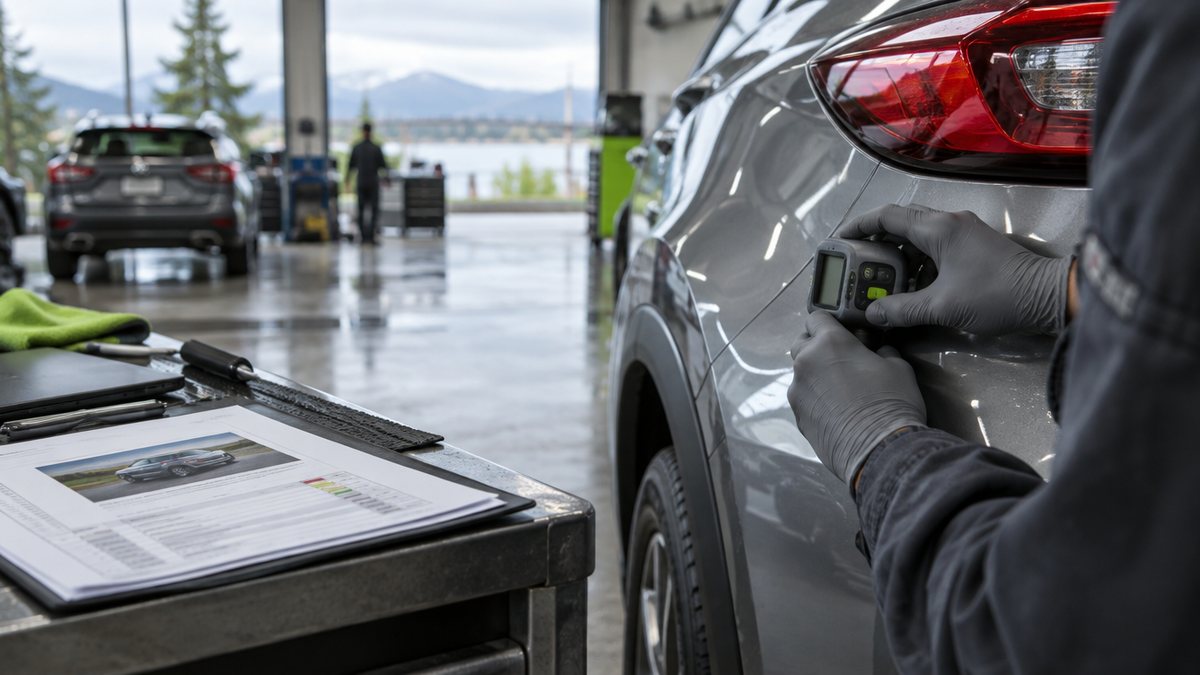
- Paint depth. A $60 paint-depth gauge reads factory paint at roughly 90 to 150 microns on most cars. A repainted panel reads higher, and body filler reads much higher. Our inspectors check every panel on every car we list.
- Panel gaps and door alignment. Run a finger along the hood-to-fender and door-to-quarter gaps. They should be even top to bottom and match the other side.
- Bolt heads and factory markings. Fender and hood bolts that have been turned show broken paint. Replaced parts lack the manufacturer's stamp or have an aftermarket label (CAPA, or a parts brand).
- Headlight and taillight dating. Lights carry a date of manufacture. One that is two years newer than the car and the others is a replacement.
- Alignment and tire wear. A car that pulls, or that has uneven inner-edge wear on one front tire, may have a bent suspension component from the impact even if the body was repaired.
Frequently Asked Questions
How much accident history is too much on a used car?
As a rule of thumb, claims under about $3,000 at a bumper or single panel with no airbag deployment are cosmetic. Claims over $10,000, any structural or frame repair, any airbag deployment, or a status other than Normal are where most buyers should walk away or get a body-shop inspection before proceeding.
Does a CARFAX claim mean the car was in an accident?
Not always. In BC, CARFAX includes ICBC claims data, which covers glass, theft, vandalism, hail and hit-and-run claims where the car was parked. Look for a point of impact and a collision description before assuming a crash.
What accident damage does a BC dealer have to disclose?
Under the Motor Dealer Act Regulation, a licensed dealer must disclose in writing damage requiring repairs over $2,000, along with out-of-province registration, prior use as a taxi, police or rental vehicle, and rebuilt or salvage status. Private sellers have no equivalent duty.
How much does an accident lower a used car's value?
A minor cosmetic claim has little effect. A moderate, properly repaired accident typically reduces resale by 5 to 15 percent. Structural damage or a rebuilt status can reduce value by 20 to 40 percent and makes the car harder to finance and resell.
Should I buy a used car with airbag deployment on the CARFAX?
Only with the full repair invoice showing new airbags, replaced sensors and a cleared airbag module, plus a body-shop inspection. Deployment means the impact was hard enough to trigger the sensors, and airbag repairs are where corners most often get cut.
Is a car with two small claims worse than a car with one big claim?
No. Two $1,500 bumper claims are cosmetic history. One $12,000 structural claim is a fundamentally different car. Judge claims by amount, location and airbag deployment, not by count.
What we actually see at our New Westminster showroom
We buy cars at auction and on trade every week, and we pass on a lot of them because of the CARFAX. The ones we pass on are rarely the two-claim cars; they are the single-claim cars where the amount is $11,000 with no invoice, or where the airbag line is there and the seller shrugs. The ones we happily list are the Corollas and RAV4s with a $2,400 rear bumper from a Metrotown parkade, repaired at an ICBC-accredited shop, with paint that reads factory-thin everywhere except one panel.
Every car on our lot has its CARFAX linked on the listing and the written disclosure filled in before you ask. If a claim is over $2,000 you will see it on the sticker, on the listing and on the form, because that is the law and because a buyer who finds it later never comes back.
Sources & official references
This guide reflects our day-to-day experience at our New Westminster showroom and is cross-checked against official sources. Rules, rates and warranty terms change; always confirm current details with:
Every Spinny Assured car comes with its CARFAX
Read the full report before you visit, then see the 150-point inspection that backs it up.